
Información de la revista
Images in Paediatrics
Acceso a texto completo
Disponible online el 4 de diciembre de 2025
Lego player foot
Callosidad talar infantil
Visitas
97
Lorena Jiménez Molinaa,
Autor para correspondencia
, María Lozano Garcíab, Ana Garach Gómezb
a Servicio de Pediatría, Hospital Materno Infantil Virgen de las Nieves, Granada, Spain
b Centro de Salud Zaidín Sur. Distrito Granada-Metropolitano, Granada, Spain
Este artículo ha recibido
Información del artículo
Texto completo
Bibliografía
Descargar PDF
Estadísticas
Figuras (3)
Mostrar másMostrar menos
Texto completo

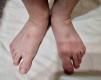
A boy aged five years presented with bilateral hard and hyperpigmented masses in the dorsum of both feet of that had formed over several years. The masses were painless and caused no functional limitations (Fig. 1).

Figure 1.

Bilateral hard and hyperpigmented masses in the dorsal aspect of the foot.

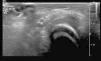
The ultrasound examination (Fig. 2) showed hypoechoic thickening of the subcutaneous tissue anterior to the Chopart joint with no increase in Doppler signal.

Figure 2.

Ultrasound of the ankle. Hypoechoic thickening of the subcutaneous tissue in the forefoot without increased signal on Doppler.

The clinical and sonographic findings were compatible with talar callosities, a benign condition infrequent in Western countries.1,2 They are characterized by the development of painless hyperkeratotic plaques in the dorsal aspect of the feet.

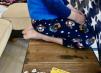
These lesions are associated with the habit of sitting in a kneeling position with the feet tucked under the glutes, so that the dorsum of the foot is resting against a hard surface for prolonged periods of time (Fig. 3). Recently, the term “lego player foot” was proposed to illustrate its development in children who stay in this position for a long time while they play.

Figure 3.

Usual position adopted by the patient: kneeling on a hard surface with the feet flexed under the glutes.

The diagnosis of Lego player foot is chiefly based on the clinical presentation. Sonography completes the evaluation, as it allows ruling out other lesions with a poorer prognosis.3 It does not require specific treatment and tends to resolve spontaneously when the mechanical stress is removed. It is more prevalent in Asian countries, where walking barefoot and sitting on the floor are more common practices.


References
[1]
K.B.L. Lim, D.K. Tawng, E.S. Lokino, R. Raveendran, G.T. Tay.
Talar callosity in children - what, who, why?.
J Pediatr., 158 (2011), pp. 340
[2]
M. Minkov, M. Minkov, K. Lakatos.
The Diligent Lego Player with Talocalcaneal Callosities.
J Pediatr., 270 (2024),
[3]
L. Luna-Bastante, E. López Negrete, L. Alonso Naranjo, G. Roustan, F. Alfageme.
Sonography of a case series of talar callosities.
J Ultrasound., 25 (2022), pp. 983-987
Copyright © 2025. Asociación Española de Pediatría
Descargar PDF
Idiomas
Anales de Pediatría
Opciones de artículo
Herramientas
