
Sugerencias
Compartir
Información de la revista
Vol. 102. Núm. 1.
(Enero 2025)
Images in Paediatrics
Acceso a texto completo
A rare genetic cause of translucent teeth
Una causa genética rara de dientes translúcidos
Visitas
1850
Sara Nogueira Machadoa,
Autor para correspondencia
, Cecília Gomes Pereiraa, Cátia Moreirab, Rita Rodriguesc,d
a Servicio de Pediatría, Unidad Local de Salud de Alto Ave, Guimarães, Portugal
b Odontología, Clínica Sónia Costa, Oporto, Portugal
c Odontología Pediátrica, UFP-FCS, FP I31ID, Oporto, Portugal
d Odontología Pediátrica, Clínica Sónia Costa, Oporto, Portugal
Este artículo ha recibido
Información del artículo
Texto completo
Bibliografía
Descargar PDF
Estadísticas
Figuras (2)
Texto completo

Dentinogenesis imperfecta (DI) is a rare autosomal dominant hereditary dentin disorder characterized by tooth discolouration and translucency in both the deciduous and permanent teeth.1 Previous studies suggest that DI affects approximately 1 in every 6000–8000 individuals.2 To date, the dentin sialophosphoprotein (DSPP) gene is the only gene with variants known to cause DI, with over 50 heterozygous changes identified to date.3

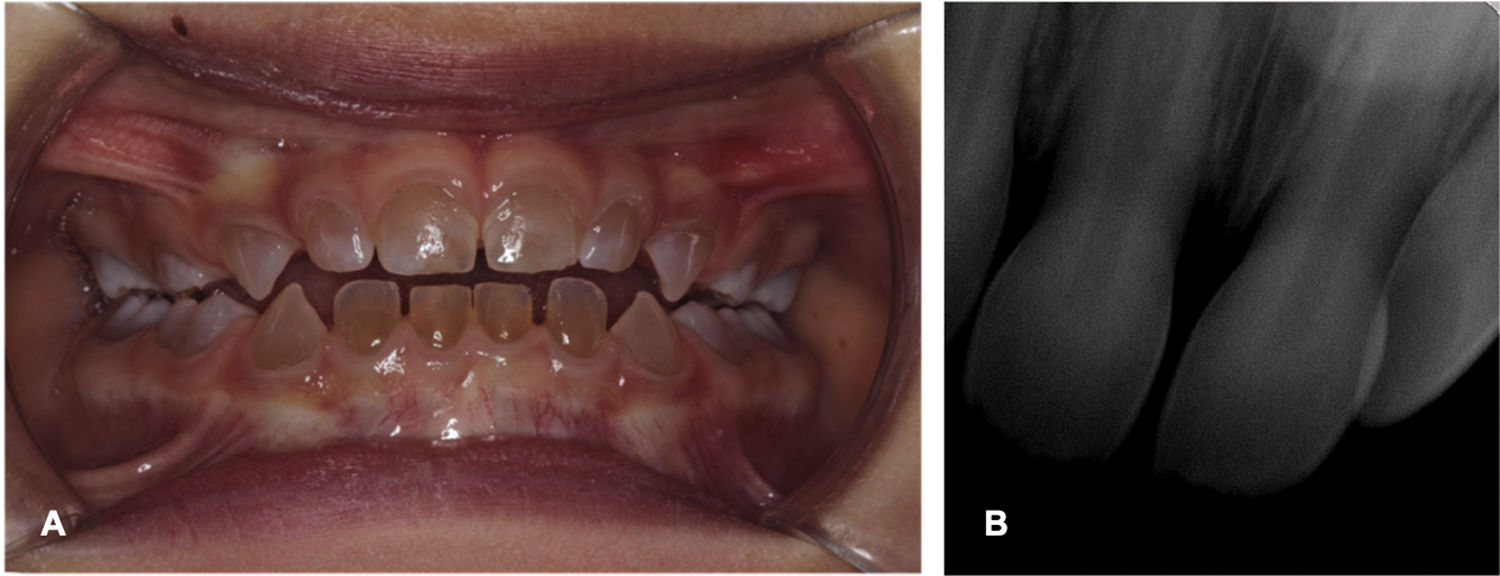
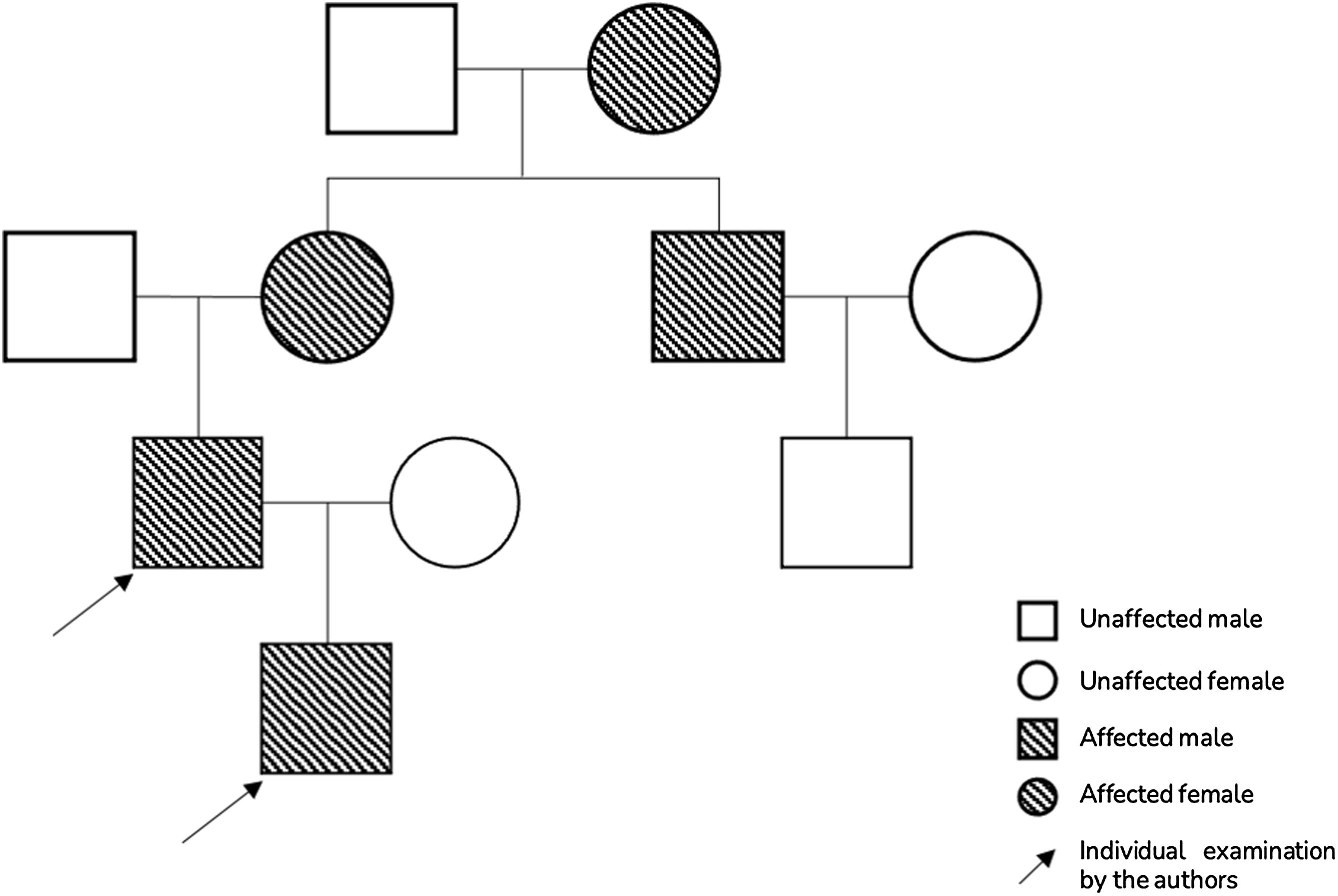
We present the case of a male infant aged 7 months referred by his outpatient care paediatrician to a paediatric dentistry clinic due to the yellowish discoloration and amber-hued translucency of his deciduous teeth (Fig. 1 A). Periapical radiographs revealed obliteration of two-thirds of the pulp chambers, with no discernible changes in enamel thickness, crown structure or root size (Fig. 1 B). A review of the patient’s family history revealed similar dental anomalies in his father, paternal grandmother, paternal great-uncle and paternal great-grandmother (Fig. 2). Sequencing of the DSPP gene in the patient identified a novel likely pathogenic variant [c.3047del p.(Ser1016llefs*298)] that may explain the presented clinical case.

Figure 1.

Clinical examination and radiography. (A) Clinical examination of the patient at age 27 months with complete deciduous dentition. (B) Periapical radiographs revealing obliteration of two-thirds of the pulp chambers.

Figure 2.

Pedigree of dentinogenesis imperfecta in the family of the patient based on medical records, spanning 4 generations.

In cases of genetic dental anomalies, early diagnosis and referral to a paediatric dentist are crucial to prevent early deterioration and loss of teeth.2 This case report underscores the vital role of paediatricians in recognizing the early signs of the often-overlooked dental alterations that can affect a child’s physical and psychosocial well-being.


References
[1]
X. Zhang, L. Chen, J. Liu, Z. Zhao, E. Qu, X. Wang, et al.
A novel DSPP mutation is associated with type II dentinogenesis imperfecta in a Chinese family.
BMC Med Genet, 8 (2007), pp. 52
[2]
A. Garrocho-Rangel, I. Dávila-Zapata, R. Martinez-Rider, S. Ruiz-Rodriguez, A. Pozos-Guillén.
Dentinogenesis imperfecta type II in children: a scoping review.
J Clin Pediatr Dent, 43 (2019), pp. 147-154
[3]
Q. Du, L. Cao, Y. Liu, C. Pang, S. Wu, L. Zheng, et al.
Phenotype and molecular characterizations of a family with dentinogenesis imperfecta shields type II with a novel DSPP mutation.
Ann Transl Med, 9 (2021), pp. 1672
Copyright © 2024. Asociación Española de Pediatría
Descargar PDF
Idiomas
Anales de Pediatría
Opciones de artículo
Herramientas
