Seasonal influenza represents a significant burden in childhood. This article analyzes pediatric influenza vaccination during the 2025−2026 campaign, as well as epidemiological, effectiveness, and preliminary vaccination coverage data. Routine vaccination against influenza between ages 6 and 59 months, as well as the extension of the recommendation up to 17 years, as outlined in the 2025 AEV, CAV-AEP, and SEIP consensus document, is key to individual and collective protection. We propose advancing further in developing effective strategies to continue increasing vaccination coverage, as well as expanding the age range for vaccination, as has already been implemented in some autonomous communities in 2025−2026.
La gripe estacional representa una carga significativa en la edad pediátrica. Este artículo analiza la vacunación antigripal pediátrica durante la campaña 2025−2026, así como la epidemiología, la efectividad y las coberturas de vacunación provisionales. La inmunización sistemática frente a la gripe entre los 6 y los 59 meses de edad, así como la extensión de la recomendación hasta los 17 años, tal y como se recogió en el documento de consenso AEV, CAV-AEP y SEIP de 2025, es clave para la protección individual y colectiva. Se propone seguir avanzando en estrategias efectivas para continuar aumentando las coberturas vacunales, así como en la ampliación de la edad de vacunación iniciada ya en la campaña 2025−2026 en algunas comunidades autónomas (CC.AA.).
Seasonal influenza is a recurring challenge that affects between 30% and 40% of the pediatric population with approximately 1 billion cases worldwide each year, including 2–4 million severe cases in children under 18 years, of which 1 million, and nearly 30 000 deaths, occur in children aged less than 5 years.1 Influenza is responsible for a large number of primary care and emergency department visits, as well as for the use of antibiotics and absences from work and school. Between 60% and 80% of children hospitalized for influenza and nearly half of the children who die from the disease were previously healthy and had no underlying medical conditions or risk factors.
Vaccination is the most effective preventive measure against influenza in terms of reducing the burden of disease, the incidence of complications, and community transmission. In 2012, the World Health Organization (WHO)2 recommended routine influenza vaccination for children aged 6–59 months. In the 2022−2023 season, Andalusia, Galicia, and the Region of Murcia were the first autonomous communities (ACs) in Spain to introduce routine influenza vaccination in that age group, ahead of the official recommendation made by the Ministry of Health3 to include it in the national lifelong vaccination schedule for 2023, a measure that was implemented in the rest of the autonomous communities and cities from the 2023−2024 campaign.
There is ample evidence that vaccinating children and adolescents has a significant impact on the transmission of influenza and on reducing the number of cases and the incidence of complications,4 and that each season the influenza epidemic begins with an increase in cases among children and adolescents, preceding infection in older age groups by a few weeks, as they are the primary transmitters of the disease.5
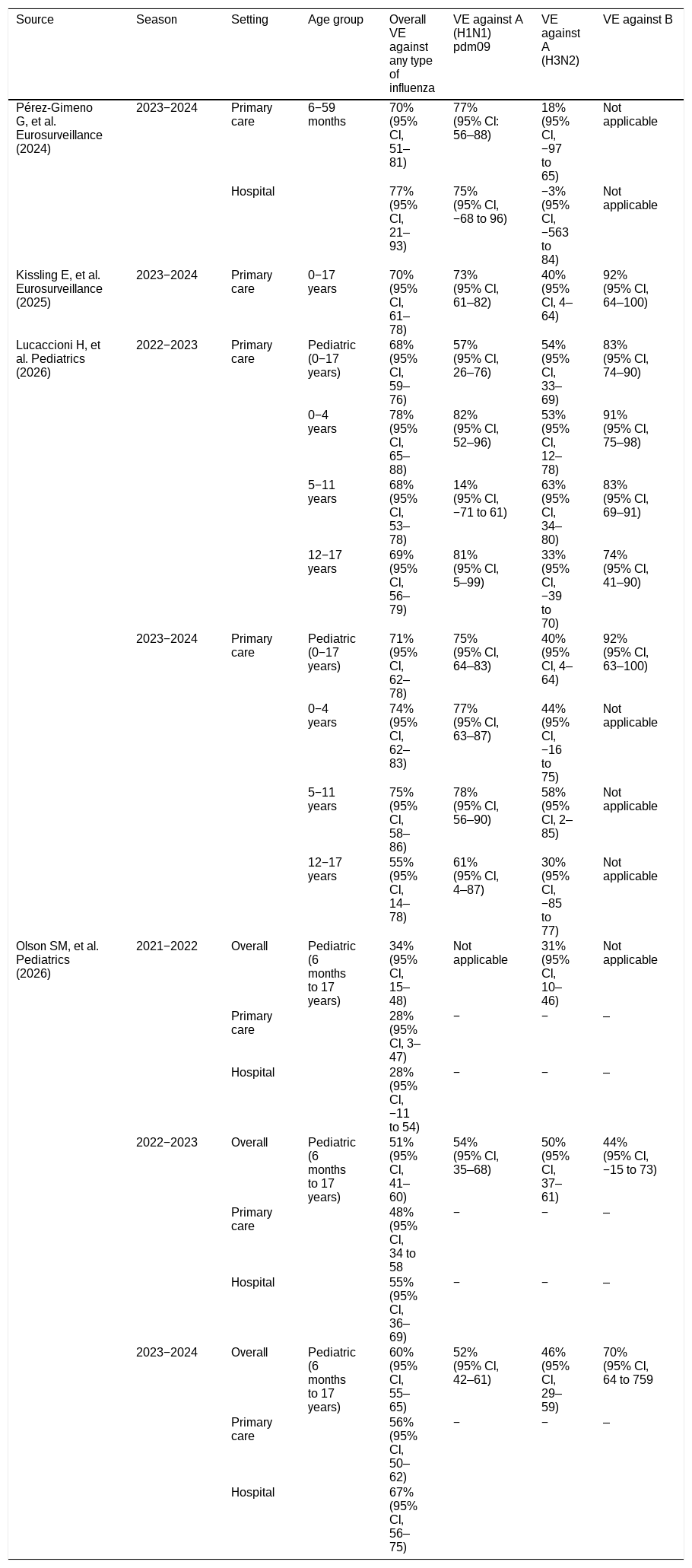
Vaccine effectiveness (VE) varies according to age, the type of vaccine, and the antigenic match.6,7 In general, data from recent seasons consistently show that the VE is higher in children compared to adults. Table 1 presents a summary of the effectiveness data from four multicenter observational test-negative case-control studies: one conducted in Spain in children aged 6–59 months during the 2022−2023 season,8 in which A(H1N1)pdm09 predominated (61.2% of typed cases of influenza managed at the primary care level and 43.8% of cases requiring hospitalization); two studies conducted in European countries, including Spain, in the pediatric population (0−17 years) at the primary care level during seasons 2022−2023 and 2023−2024, with predominance of subtype A(H3N2) and type B in the former and A(H1N1)pdm09 in the latter9,10; and a study conducted in the United States in seasons 2021−2022 to 2023−2024, with predominance of subtype A(H3N2) in the first two seasons (88% and 65% of cases, respectively), and of type B (45%) followed by A(H1N1) (34%) in the last season.11
Summary of selected studies on the effectiveness of influenza vaccination in children and adolescents.
| Source | Season | Setting | Age group | Overall VE against any type of influenza | VE against A(H1N1)pdm09 | VE against A(H3N2) | VE against B |
|---|---|---|---|---|---|---|---|
| Pérez-Gimeno G, et al. Eurosurveillance (2024) | 2023−2024 | Primary care | 6−59 months | 70% (95% CI, 51–81) | 77% (95% CI: 56–88) | 18% (95% CI, −97 to 65) | Not applicable |
| Hospital | 77% (95% CI, 21–93) | 75% (95% CI, −68 to 96) | −3% (95% CI, −563 to 84) | Not applicable | |||
| Kissling E, et al. Eurosurveillance (2025) | 2023−2024 | Primary care | 0−17 years | 70% (95% CI, 61–78) | 73% (95% CI, 61–82) | 40% (95% CI, 4–64) | 92% (95% CI, 64–100) |
| Lucaccioni H, et al. Pediatrics (2026) | 2022−2023 | Primary care | Pediatric (0−17 years) | 68% (95% CI, 59–76) | 57% (95% CI, 26–76) | 54% (95% CI, 33–69) | 83% (95% CI, 74–90) |
| 0−4 years | 78% (95% CI, 65–88) | 82% (95% CI, 52–96) | 53% (95% CI, 12–78) | 91% (95% CI, 75–98) | |||
| 5−11 years | 68% (95% CI, 53–78) | 14% (95% CI, −71 to 61) | 63% (95% CI, 34–80) | 83% (95% CI, 69–91) | |||
| 12−17 years | 69% (95% CI, 56–79) | 81% (95% CI, 5–99) | 33% (95% CI, −39 to 70) | 74% (95% CI, 41–90) | |||
| 2023−2024 | Primary care | Pediatric (0−17 years) | 71% (95% CI, 62–78) | 75% (95% CI, 64–83) | 40% (95% CI, 4–64) | 92% (95% CI, 63–100) | |
| 0−4 years | 74% (95% CI, 62–83) | 77% (95% CI, 63–87) | 44% (95% CI, −16 to 75) | Not applicable | |||
| 5−11 years | 75% (95% CI, 58–86) | 78% (95% CI, 56–90) | 58% (95% CI, 2–85) | Not applicable | |||
| 12−17 years | 55% (95% CI, 14–78) | 61% (95% CI, 4–87) | 30% (95% CI, −85 to 77) | Not applicable | |||
| Olson SM, et al. Pediatrics (2026) | 2021−2022 | Overall | Pediatric (6 months to 17 years) | 34% (95% CI, 15–48) | Not applicable | 31% (95% CI, 10–46) | Not applicable |
| Primary care | 28% (95% CI, 3–47) | − | − | – | |||
| Hospital | 28% (95% CI, −11 to 54) | − | − | – | |||
| 2022−2023 | Overall | Pediatric (6 months to 17 years) | 51% (95% CI, 41–60) | 54% (95% CI, 35–68) | 50% (95% CI, 37–61) | 44% (95% CI, −15 to 73) | |
| Primary care | 48% (95% CI, 34 to 58 | − | − | – | |||
| Hospital | 55% (95% CI, 36–69) | − | − | – | |||
| 2023−2024 | Overall | Pediatric (6 months to 17 years) | 60% (95% CI, 55–65) | 52% (95% CI, 42–61) | 46% (95% CI, 29–59) | 70% (95% CI, 64 to 759 | |
| Primary care | 56% (95% CI, 50–62) | − | − | – | |||
| Hospital | 67% (95% CI, 56–75) |
In its recommendations for influenza vaccination in the 2026–2027 season, the CAV-AEP (Advisory Committee on Vaccines and Immunizations of the Asociación Española de Pediatría [AEP, Spanish Association of Pediatrics])12 continues to advocate, as it did in the previous season, for routine immunization of children aged 6 months to 17 years, as noted in the consensus document of the CAV-AEP, the Asociación Española de Vacunología (AEV, Spanish Association of Vaccinology), and the Sociedad Española de Infectología Pediátrica (SEIP, Spanish Society of Pediatric Infectious Diseases) published in this journal in 2025,13 as it is key for individual and collective protection, prioritizing the use of the intranasal attenuated vaccine from 2 years on account of its greater acceptability14,15 and its particular mechanism of action, which generates mucosal immunity and therefore reduces transmission of the virus. In this document, we review the epidemiological trends of the 2025−2026 season, the available vaccine effectiveness data, and interim vaccination coverage data, and assess the progress made in the past campaign and the challenges that must be addressed in the 2026–2027 campaign.
Epidemiology in the 2025−2026 influenza seasonThe 2025−2026 season was of moderate intensity (threshold ranging from 162 to 218 cases per 100 000 inhabitants); it began early, crossing the epidemic threshold in the third week of November 2025 (week 47), with the incidence peaking between weeks 49 and 51 (peak at week 50, 197.7 per 100 000 inhabitants) followed by a gradual decline through week 3 of 2026, for a total duration of 9 weeks above the epidemic threshold.16
Children aged less than 14 years contributed significantly, with a high volume of visits to both primary care centers and hospital emergency departments. The highest frequency of hospitalization due to influenza occurred in the group aged 80 years or older, followed by infants aged less than 12 months.16
Influenza A(H3N2) was the predominant virus (with 99.4% of cases corresponding to subclade 3C.2a1b.2a.2a.3a.1/K, known as antigenically drifted subclade K), followed by A(H1N1)pdm09. The circulation of lineage B/Victoria was limited, and there were no documented cases of linage B/Yamagata, which has not been in circulation since March 2020.
Effectiveness of vaccination in the 2025−2026 seasonDomestic VE data are not yet available for Spain, but a study has been published that analyzed interim 2025/26 VE results from nine European studies conducted in a total of 19 countries, including Spain, across outpatient and hospital settings.17 Among the cases of influenza type A, 85% involved subtype A(H3N2), with the proportion ranging from 63% to 93% across contributing sites. Sequencing results were available from five of the studies: Among genetically characterized influenza A(H3N2) viruses, 94% (1319/1398) belonged to subclade K, with proportions ranging from 84% to 97% across contributing sites. All-age VE against influenza A(H3N2) ranged from 38% to 50%. Vaccine effectiveness was consistently higher in children and adolescents aged less than 18 years (51%–82%), while it ranged from 5% to 35% in adults aged 18–64 years and from 26% to 33% in adults aged 65 years and older. All-age estimates against subclade K were 38% and 41% in the three primary care studies, and 50% at the hospital level. Thus, VE was higher in children and moderate in adults, despite the antigenic mismatch.17
Data from other countries confirm the higher VE in children compared to adults. Thus, in the United Kingdom, the VE against influenza A(H3N2) subclade K has been estimated to be between 72% and 75% in children and adolescents (aged 2–17) and between 32% and 39% in adults, depending on the age group, according to interim data from the UK Health Security Agency (UKHSA).18 In the United States, interim VE estimates for children and adolescents ranged from 38% to 41% (95% CI, 25–53) against influenza outpatient visits and 41% (95% CI, 20–56) against hospitalization. Among adults, the VE ranged between 22% and 34% against outpatient visits and was estimated at 30% against hospitalization. Among children and adolescents, the VE against outpatient visits for influenza A was 37% and the VE against hospitalization was 42%, while the VE against A(H3N2) was 35% for outpatient visits and 38% for hospitalization. The VE against influenza B outpatient visits ranged from 45% to 71% among children and adolescents and was 63% among adults.19
Implementation and vaccine coverage in the 2025−2026 campaignIn the 2025−2026 campaign, some ACs expanded routine vaccination beyond 59 months: up to age 6 years (Valencian Community, Balearic Islands, Canary Islands), age 7 years (Aragon), age 8 years (Castile and León), age 9 years (Region of Murcia), and age 11 years (Galicia, La Rioja).
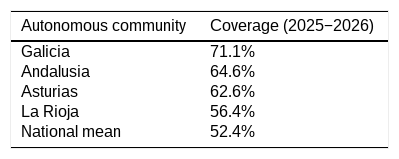
In Spain, according to data from the SIVAMIN, the statistics portal of the Ministry of Health, influenza vaccination coverage among children aged 1–4 years during the 2025−2026 season, as of July 29, was 52.4%, exceeding the coverage of the previous campaign (45.5%), with increases in every AC.20 In some ACs,20 the coverage even exceeded the 60% target established for this age group by the Ministry of Health since the 2025−2026 recommendations21 (Table 2).
Vaccination coverage rates based on official reports.20
| Autonomous community | Coverage (2025−2026) |
|---|---|
| Galicia | 71.1% |
| Andalusia | 64.6% |
| Asturias | 62.6% |
| La Rioja | 56.4% |
| National mean | 52.4% |
While Spain is one of the European countries where the overall confidence in vaccines is highest (77%), the confidence is lower when it comes to the flu vaccine (57%), although it is still the highest in Europe.22 It is striking that, after just three seasons of routine vaccination for children aged 6–59 months, Spain turned out to be the European country with the highest pediatric vaccination coverage in the 2024–2025 campaign, followed by Finland (32.9%) and Iceland (22.2%) at some distance.23 In the United Kingdom, a country with longer experience in school-based vaccination, coverage ranged from 45% to 55% for secondary school children, 55%–67% for primary school children, and 30%–50% for preschool children24.
For the 2026–2027 season, at the time of writing, Cantabria and the Community of Madrid have announced that they will expand pediatric universal influenza vaccination to up to age 7 years, Castile and León, the Region of Murcia and Extremadura to up to age 11 years, the Principality of Asturias and La Rioja to age 13 years, and the Autonomous City of Melilla to age 17 years, with other ACs expected to expand vaccination to other age groups as well.
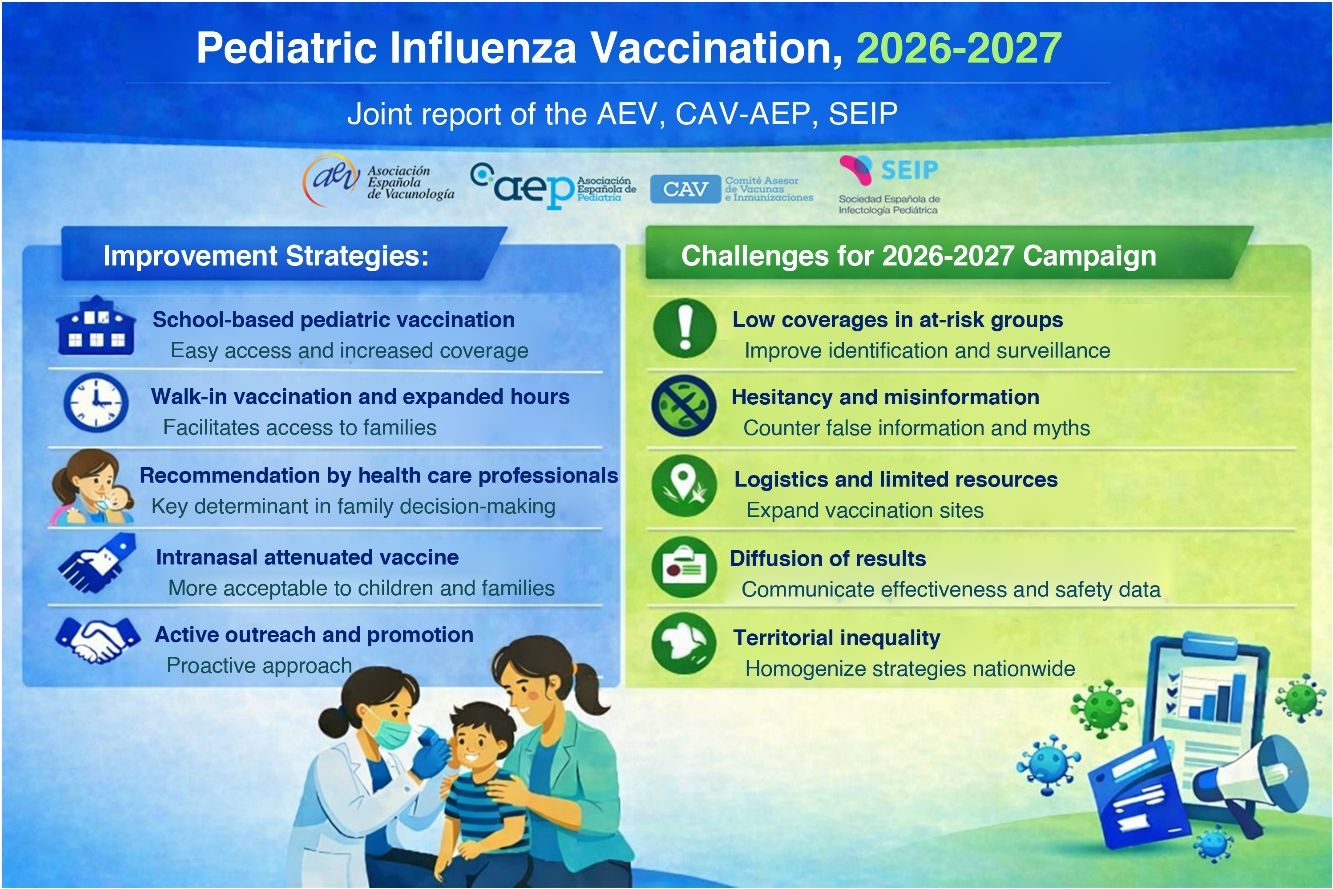
Vaccination strategiesBeyond the need for a routine immunization schedule that includes influenza vaccination for children and adolescents as well as at-risk groups, establishing strategies to increase vaccination coverage among the target populations is essential. The most effective strategies for increasing vaccination coverage are those that focus on information, education, recommendation, accessibility, acceptability, and proactive outreach.13 Conventional educational campaigns and posters have historically had little effect when used in isolation. In practice, the most effective measures implemented in Spain are:
- 1
School-based vaccination. It is one of the most effective interventions,14 as it reduces logistical barriers, maximizes intervention throughput and operational capacity, saves parents time by eliminating the need to travel to the primary care center, and is associated with significant increases in vaccination coverage compared to passive strategies, as observed in the ACs of Andalusia, Galicia, La Rioja and the Region of Murcia.
- 2
Walk-in vaccination, extended vaccination hours or vaccination in alternative settings. Extending vaccination hours to evenings and weekends or establishing vaccination sites in convenient locations, such as department stores or shopping malls, expands access to vaccination for working families. Past experiences with expanded access through this type of strategies in Andalusia, Asturias and Galicia achieved an increase in vaccination coverage compared to previous campaigns and to ACs that did not implement these measures.
- 3
Active recommendation by health care professionals. This is the factor with the greatest impact on parental decisions regarding vaccination.25 Training of health care professionals improves active recommendation. In addition, the alignment of the recommendations issued by scientific societies and by the health care authorities reinforces the confidence of families and facilitates the implementation of vaccination programs.
- 4
Use of the intranasal vaccine. Due to its greater acceptability compared to the intramuscular vaccine for children and adolescents, families, and health care providers, the intranasal vaccine is a useful tool for increasing coverage, especially in school-based programs.
Thus, recommending vaccination through age 17 years is not the sole priority, but making vaccination accessible and visible for families is also important. Some ACs that have implemented high-impact measures have achieved significantly greater coverages, which demonstrates that combining different strategies, as opposed to isolated measures, is the most effective approach. In the case of infants aged less than 6 months, vaccination efforts must focus on their household contacts and caregivers, with particular emphasis on vaccination of pregnant women in any trimester of gestation, which is a key intervention for the indirect protection of the infant in the first months of life.
In short, the most adequate strategy is a mixed model involving proactive outreach, improved accessibility, school-based vaccination, professional recommendation and the preferential use of the intranasal vaccine from age 2 years, as it is the strategy most aligned with the available evidence and that best addresses the current barriers to influenza vaccination in Spain.
Challenges in pediatric influenza vaccination for the 2026–2027 campaignAlthough Spain leads Europe in pediatric influenza vaccination coverage, the coverage is still “modest” compared to other vaccines, with challenges regarding acceptability, accessibility, and uptake that need to be addressed to improve it and reach the coverages achieved for other diseases, for instance, in the immunization against respiratory syncytial virus.
The main challenges for the 2026–2027 influenza vaccination campaign involve building on the strengths already identified, addressing persistent weaknesses, anticipating threats, and capitalizing on opportunities for improvement.
Among the weaknesses, we ought to highlight the substantial room for improvement in vaccination coverage (especially in risk groups, in which identification and surveillance are inherently difficult26) and the gap between the issued recommendations and their actual implementation in some health care settings; there is also the low coverage among health care professionals (40.0% in the 2024–2025 season and 45.5% in the 2025−2026 season, according to data available through the SIVAMIN as of this writing), with significant variation between ACs, stemming, among other factors, from doubts regarding the importance of vaccination, its effectiveness in preventing the disease and its complications, and its adverse effects. More training is required. A professional who has no confidence in the vaccine is not likely to educate others about it or actively engage in the improvements that are currently being pursued. Chief among the threats is the specific influenza vaccine hesitancy, the perception that influenza carries a low risk, the occasional antigenic mismatch, and the uneven implementation of improvement strategies in different regions.
Among the strengths are the solid evidence and regulations that back vaccination programs, the nationwide recommendation of routine immunization through age 59 months, expanded to other pediatric age groups in more than half the ACs, the demonstrated acceptability of the intranasal vaccine, and the evidence on the effectiveness and safety of pediatric vaccination against influenza.
The main opportunities include expanding school-based vaccination throughout Spain, strengthening proactive outreach for vaccination of at-risk children and adolescents, improving coordination and communication among pediatricians, nurses, public health officials, community pharmacists, and schools, and leveraging digital communication to better reach families.
Key challenges- •
Vaccination coverage is inadequate and could be improved among at-risk groups: this heterogeneous and fluctuating population of patients requires standardized identification systems and prioritized proactive outreach.
- •
Vaccine hesitancy and acceptability of annual vaccination: the perception of the flu as a mild illness must be actively countered through the firm recommendation of health care professionals and effective communication strategies, with particular emphasis on social media.
- •
Campaign logistics: increasing accessibility by making vaccination compatible with work and school schedules. This requires continuing to expand walk-in vaccination, extended hours, offering vaccination at convenient alternative sites (such as department stores and shopping malls), and school-based vaccination.
- •
Feedback on vaccination outcomes: reporting the high effectiveness of the vaccine in children and the overall results of the campaign to both health care professionals and the general public is essential in order to strengthen confidence in the value of vaccination.
- •
Territorial inequalities in policy and resources: further and ongoing efforts are needed to harmonize vaccination strategies and the ages at which vaccination is recommended across ACs in order to avoid inequality and until universal pediatric vaccination through age 17 years is implemented nationwide.
Data from the 2025−2026 campaign reveal an epidemic season of moderate intensity dominated by A(H3N2) subclade K, with a substantial VE in the pediatric population in spite of the antigenic mismatch, and a greater vaccination coverage compared to previous seasons that exceeded 52%, making the coverage in Spain the highest in Europe. From the AEV, the CAV-AEP, and the SEIP, we will continue to advocate for universal vaccination up to and including age 17 years, the preferential use of the intranasal vaccine from age 2 years as long as it is not contraindicated, and the prioritization of vaccination of patients in risk groups, their household contacts, and the school and health care professionals that care for them. For the 2026–2027 season, we propose promoting and expanding school-based vaccination to continue to increase vaccination coverages and to reduce the burden of influenza in children and adolescents.
FundingThe development of these recommendations (analysis of the published data, debate, consensus and publication) has not been supported by any funding source outside of the logistic support provided by the AEP.
Javier Álvalrez Aldeán has collaborated in educational activities funded by AstraZeneca, GlaxoSmithKline, Sanofi, and Seqirus; as a researcher in clinical trials for GlaxoSmithKline and Sanofi, and as a consultant in AstraZeneca, GlaxoSmithKline, Sanofi, and Seqirus advisory boards.
Francisco José Álvarez García has collaborated in educational activities funded by AstraZeneca, GlaxoSmithKline, and Sanofi, and as a consultant in GlaxoSmithKline and Sanofi advisory boards.
Fernando Baquero Artigao has collaborated in educational activities funded by AstraZeneca and GlaxoSmithKline, and served as an advisory board consultant for GlaxoSmithKline.
Marta Cruz Cañete reports no conflicts of interest.
María Fernández Prada has collaborated in educational activities funded by AstraZeneca, GlaxoSmithKline, Sanofi, Sanofi-Genzyme, Seqirus, and Novavax, and as a consultant in GlaxoSmithKline, Sanofi, Sanofi-Genzyme, Seqirus, and Novavax advisory boards.
Laura Francisco González reports no conflicts of interest.
Ana María Grande Tejada has collaborated in educational activities funded by Sanofi, AstraZeneca, GlaxoSmithKline, and Seqirus, and served as an advisory board consultant for Sanofi.
Antonio Iofrío de Arce has collaborated in educational activities funded by GlaxoSmithKline and Sanofi, and served as an advisory board consultant for GlaxoSmithKline.
Alejandra Méndez Sánchez has collaborated in educational activities funded by GlaxoSmithKline.
Fernando Moraga Llop, in relation to vaccination against influenza, reports receiving fees from AstraZeneca, GlaxoSmithKline, Sanofi, and Seqirus for collaborating in educational activities and as a consultant.
Ignacio Salamanca de la Cueva has collaborated in educational activities funded by GlaxoSmithKline, Sanofi, Seqirus, and Moderna, as a researcher in vaccine trials for AstraZeneca, GlaxoSmithKline, Moderna, Novavax, Sanofi, and Seqirus, and as a consultant in AstraZeneca, GlaxoSmithKline, Moderna, and Sanofi advisory boards.